Recovery Coach for Young Adults: Navigating the Path to Independent Living
- Cindy Feinberg, CPC, CAI

- Jul 21
- 13 min read
Updated: 6 days ago
What if the missing piece to your child's lasting sobriety isn't another month in a clinical facility, but a practical bridge to the life that happens after? You've likely watched the cycle repeat: the hopeful discharge, the return home, and the slow, painful slide back into old patterns. It's exhausting to feel like you're walking on eggshells while your young adult remains stalled in a state of "failure to launch." You want them to thrive, yet the tension in your home has become a constant, heavy weight.
Engaging a recovery coach for young adults provides the necessary scaffolding between the safety of treatment and the messy complexities of real-world independence. It's about more than just staying sober; it's about building the executive function skills required to navigate adulthood. In this article, you'll discover how specialized coaching bridges the gap between clinical care and independent living. We'll explore how this hands-on support restores academic momentum, heals family trust, and transforms parental dependence into a foundation of true self-accountability.
Table of Contents
The Unique Challenges of Recovery in Young Adulthood
You've watched the door close on a short-term treatment program with a mixture of relief and terror. You've wondered if they are truly ready. You've feared the first Friday night back in their old neighborhood or the first weekend back on a college campus. For many, the transition from the highly structured environment of clinical care to the absolute freedom of early adulthood feels less like a step forward and more like falling off a cliff. The stakes are incredibly high during this period because the safety net of 24/7 supervision is suddenly gone, replaced by the heavy responsibilities of independent living.
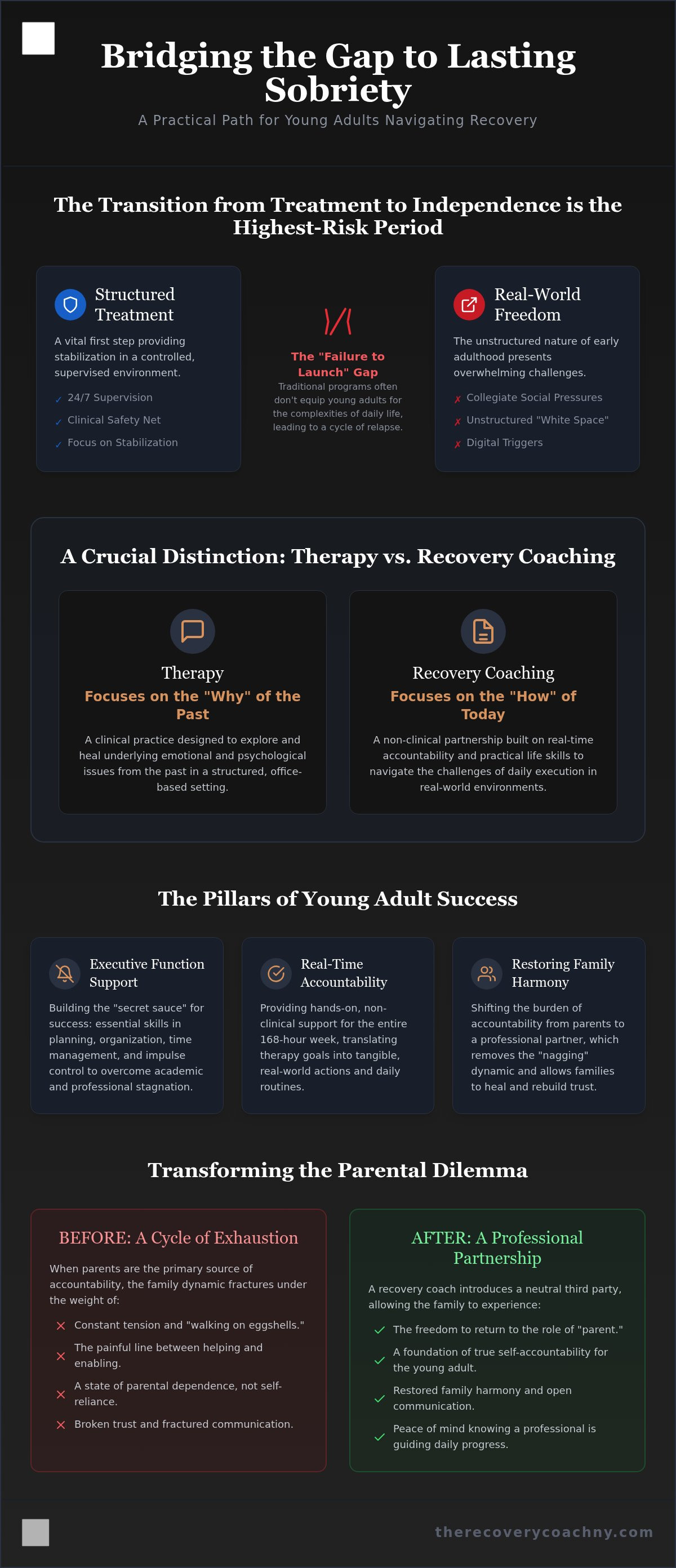
Traditional 28-day programs are vital for stabilization, but they often fail to address the long-term life skills necessary for survival in the "real world." They don't teach a 20-year-old how to manage a syllabus while craving a drink, or how to navigate a social circle where substance use is normalized. This gap is where the cycle of rehab and relapse often takes root. When a young person returns to a world filled with collegiate social pressures and digital triggers without a plan for daily execution, the results are often heartbreakingly predictable. "Failure to launch" isn't a character flaw; it's a symptom of a young adult who lacks the specific tools to balance recovery with the demands of modern adulthood.
Developmental Milestones and Mental Health
Substance use doesn't just damage the body; it often freezes emotional and cognitive development at the age when the use began. This phenomenon can leave a 24-year-old with the emotional regulation skills of a teenager. However, the young adult brain possesses incredible neuroplasticity. This means that with the right support, they can actually "rewire" their neural pathways toward healthier habits and better decision-making. In 2026 recovery models, we focus heavily on Transitional Age Youth (TAY), a designation for individuals aged 16 to 25 who are navigating the complex shift from pediatric systems and parental dependence to adult self-sufficiency. Recovery coaching acknowledges this unique developmental stage by focusing on building the "muscles" of adulthood in real-time environments rather than in a clinical vacuum.
The Parental Dilemma: Help vs. Enablement
You want to be their biggest supporter. You want to see them succeed. Yet, you find yourself checking their location at 2 a.m. or paying bills they should be handling themselves. The line between being a supportive parent and an accidental enabler is razor-thin and incredibly painful to walk. This dynamic often leads to a "failure to launch," where the young adult remains stuck in a state of dependence while the family unit fractures under the weight of broken trust. It's a cycle of exhaustion for everyone involved.
Working with a recovery coach for young adults changes this narrative completely. By introducing a third-party professional, the "nagging" dynamic is removed from the household. The coach becomes the primary point of accountability, which allows you to return to your most important role: being their parent. This shift provides the young adult with a dedicated guide who understands the nuances of their struggle, helping them build a foundation of self-accountability that clinical therapy alone cannot provide.
What is a Recovery Coach for Young Adults?
Engaging a recovery coach for young adults means moving beyond the traditional, clinical confines of a therapist's office. While a therapist often looks backward to heal the "why" of past trauma, a recovery coach is a non-clinical partner who focuses entirely on the "how" of today. This role is built on a foundation of real-time accountability and practical life-skills training. They don't just help a young person stay sober; they help them stay active, organized, and engaged with their own future. It is a partnership that prioritizes action over analysis, ensuring that the progress made in treatment translates into the daily rhythms of independent living.
A dedicated recovery coach for young adults acts as a vital bridge between the clinical team, the family unit, and the individual. They serve as a translator, ensuring that the recommendations of doctors and therapists are actually implemented in the real world. Their responsibilities are diverse and highly specialized, ranging from meticulous goal setting and crisis management to the architecture of a daily routine. This architecture is crucial for young people who may struggle with the "white space" of an unstructured day, helping them fill those hours with intentional, productive activities that build self-esteem and resilience.
A Personalized, High-Touch Partnership
For this demographic, a hybrid model of virtual check-ins and in-person sessions proves most effective because it meets them exactly where they are. In 2022, young adults aged 18-25 had the highest rate of substance use disorder at 21.0%, highlighting the urgent need for support that doesn't sleep. We provide 24/7 availability during those high-risk "trigger" moments, such as late-night social pressures or the stress of a looming academic deadline. Beyond sobriety, the coach acts as a fierce advocate in legal, academic, or professional settings, ensuring that the individual's recovery progress is recognized by the institutions that matter most to their future.
Beyond Sobriety: The Holistic Approach
Recovery is never just about the cessation of use; it's about the integration of a whole person into a meaningful life. This holistic approach includes coordinating mental health care for the 21.2 million adults who struggle with co-occurring disorders, ensuring that all aspects of their well-being are addressed simultaneously. By focusing on the "whole person," we address the systems that surround them, from physical health to social connections and academic momentum. The concierge nature of private pay coaching ensures maximum discretion and a level of responsiveness that traditional insurance-based models simply cannot match. If you're ready to move beyond the cycle of crisis and toward a structured plan for success, exploring recovery coaching services can provide the stability your family needs.
Recovery Coaching vs. Therapy: A Comparison
You've likely watched your child sit through countless therapy sessions, dissecting the past and exploring the roots of their behavior. This clinical work is essential for healing trauma and understanding the "why" behind addiction. However, a profound disconnect often exists between the insights gained in a therapist's office and the choices made on a Tuesday night. While therapy explores the past, a recovery coach for young adults executes the "how" of the present. It's the difference between understanding why you're stuck and actually finding the leverage to move forward.
The primary limitation of traditional clinical care is the math of the week. There are 168 hours in a week, yet most clinical support is confined to a single 50-minute hour. The most critical moments of a young person's recovery don't happen during that hour; they happen in the other 167. They happen when a roommate brings home alcohol, when a midterm grade is disappointing, or when the sheer weight of a Saturday afternoon feels unbearable. A coach fills this massive gap by providing a consistent presence that clinical authority figures cannot offer. Young adults often respond with less resistance to a coach because the relationship feels like a high-level partnership rather than a clinical hierarchy.
The most effective recovery plans utilize both disciplines in synergy. The therapist provides the emotional map, while the coach serves as the guide who helps the individual walk the terrain. For instance, a professional such as Tracy Kimberg can help teenagers and adults work through the psychological foundations of their behavior, allowing the coach to focus on daily execution. When a therapist identifies a trigger, the coach is there in real-time to help the young adult navigate it. This collaboration ensures that the hard-won insights of clinical work don't evaporate the moment the office door closes.
Action-Oriented Accountability
Coaching doesn't happen on a couch; it happens in the real world. It takes place in coffee shops, on college campuses, and in the home environment where life actually unfolds. This allows for real-time intervention during social triggers or periods of high academic stress. By utilizing executive function tools, a recovery coach for young adults helps them manage the granular details of daily life. This includes organizing schedules, prioritizing tasks, and building the emotional regulation skills needed to handle frustration without reaching for a substance. It is active, tactical, and entirely focused on daily execution.
The Clinical vs. Functional Gap
It's entirely possible for a young person to be "clinically stable" while remaining "functionally dependent." They may no longer be in a crisis, yet they remain stuck in a state of stagnation, unable to hold a job or pass a class. This functional gap is where many families lose hope. Case management ensures that no one falls through the cracks of a multi-provider system. By coordinating with therapists, psychiatrists, and academic advisors, a coach acts as a "resilience architect," building a structured bridge between leaving a treatment facility and truly thriving at home. This approach transforms recovery from a state of "not using" into a proactive journey toward independent adulthood.
The Pillars of Young Adult Success: Executive Function and Academics
Sobriety is the foundation of a new life, but you cannot live on a foundation alone. You need a structure. You need a roof, walls, and a way to navigate from one room to the next. Just as a physical home requires quality craftsmanship to be functional, you can learn more about NY Cabinets for expert solutions that help build a structured and organized environment. For a young person in early recovery, that structure is built through executive function. While clinical treatment removes the substance, it doesn't automatically install the life skills required to manage a checking account, show up for a 9 a.m. lecture, or regulate emotions when a project fails. This is why a recovery coach for young adults is often described as the "secret sauce" of long-term success. They provide the practical scaffolding that allows a young person to move from "not using" to "thriving."
The transition back into a high-pressure world is often where the most significant risks lie. In 2024, data showed that the treatment gap remains widest for young adults aged 18-25, with only 11.3% of those who need care actually receiving it. This gap often exists because traditional models focus on the crisis rather than the "launch." A coach helps build a "Sober Life Skills" toolkit that includes time management, organization, and healthy dopamine-seeking behaviors. By replacing the instant gratification of substances with the slow, steady reward of personal achievement, the young adult begins to see a future that is worth the effort of staying sober.
Academic Support and Scholastic Re-entry
College campuses are notoriously difficult environments for early recovery. Between the social normalization of substance use and the intense stress of finals, a student can easily feel isolated or overwhelmed. A coach acts as a strategic partner during this transition, often liaising with universities to secure medical leaves or academic accommodations. We help students develop study habits that align with a healthy dopamine reward system, ensuring they don't burn out. This level of support is critical for preventing the "sophomore slump" or the "senior slide," where the pressure of impending graduation can trigger a return to old coping mechanisms. If your child is ready to return to school, our Academic Coaching and Scholastic Support can ensure they have the structure they need to succeed.
Executive Function: The Architect of Independence
Executive Function is the cognitive engine of adult autonomy. It is the set of mental skills that includes working memory, flexible thinking, and self-control. When these skills are underdeveloped, even simple tasks like breaking down a large project into daily steps can feel impossible. A recovery coach for young adults works as a practical architect, helping the individual design a life that works. This includes creating accountability tools for financial management and career building. By mastering these small, daily routines, the young adult transitions from parental dependence to a state of self-accountability, finally finding the confidence to lead their own life.
The Path Forward: How The Recovery Coach NY Restores Families
The journey toward independence is rarely a straight line. It's often a complex weaving of progress and setbacks that can leave a family feeling depleted and hopeless. At The Recovery Coach NY, we understand that the ultimate goal isn't just to stop a specific behavior; it's to build a life that feels worth living. Led by Cindy Feinberg, who brings over 35 years of experience to the practice, our approach is rooted in the belief that every young adult requires a customized architectural plan for their recovery. These plans aren't static. They evolve as the individual grows, shifting from intensive daily support to periodic check-ins as self-accountability finally takes root.
For high-risk transitions, such as returning to a college dorm or traveling for a family event, we provide Sober Companions and Safe Transport services. This ensures that the momentum built in treatment isn't lost during the vulnerable "white space" of travel or new environments. By providing a 360-degree view of case management, we coordinate with every clinical provider in the system. This level of organization ends the "chaos" of fragmented care and allows the family to finally breathe, knowing a professional strategist is at the helm.
Ending the Family Crisis
When a child is in active struggle, the entire family enters a state of perpetual crisis response. You've likely spent years reacting to emergencies, which leaves little room for actual growth or meaningful connection. Engaging a recovery coach for young adults allows you to step out of the role of "monitor" or "enforcer." The coach becomes the primary point of contact for the young adult's daily execution, which significantly reduces parental stress and begins the slow process of healing broken trust. Investing in this solid foundation isn't just about the current month. It's about securing your child's future and restoring harmony to your home for years to come.
Getting Started with Private Coaching
The process begins with a comprehensive initial assessment where we map out both functional and clinical needs. We look at the whole person, identifying where executive function is lagging and where academic or professional support is needed most. During the first 90 days of working with a recovery coach for young adults, the focus is on establishing routines and building a baseline of stability. We work as a firm, supportive hand, guiding the individual through the daily challenges of independent living while keeping the family informed and supported. If you're ready to stop the cycle of rehab and relapse, Schedule a private consultation to begin the journey to independence.
Building a Foundation for Lasting Independence
You've carried the weight of this crisis for long enough. You've seen that clinical treatment alone isn't always enough to bridge the gap between stabilization and a successful, independent life. True recovery for a young person requires a practical architect who can build the daily routines that support long-term sobriety. It requires a focus on executive function and academic momentum to ensure they don't just survive, but thrive. Working with a recovery coach for young adults provides your child with a dedicated partner who manages the tactical details of adulthood while you return to being a parent.
Led by Cindy Feinberg, CPC, CAI, with over 35 years of experience, our practice specializes in high-touch, private-pay discretion that respects your family's privacy. We provide the comprehensive executive function and academic support necessary to turn the dream of independent living into a daily reality. It's time to move past the cycle of fear and toward a future built on accountability and hope. Restore your family's peace of mind with expert recovery coaching. You don't have to navigate this storm alone; a brighter, more stable chapter for your child is within reach.
Frequently Asked Questions
What exactly does a recovery coach for young adults do on a daily basis?
A recovery coach for young adults provides hands-on, tactical support for the granular details of daily life. This includes morning check-ins to set intentions, organizing schedules, and navigating real-time triggers as they arise. They don't just talk about goals; they help your child execute them by managing time, prioritizing tasks, and building the sustainable routines required for independent living.
How is a recovery coach different from a therapist or a sponsor?
Coaching focuses on functional execution in the present, while therapy typically addresses past trauma and clinical diagnosis. Unlike a 12-step sponsor who focuses on spiritual recovery through a specific program, a coach is a professional strategist who provides 360-degree case management. They bridge the gap between being "clinically stable" and being "functionally independent" in the real world.
Can a recovery coach help my child if they are still in college?
Yes, specialized academic coaching is a core component of support for students navigating the path to graduation. We help young adults manage campus social pressures, coordinate with university services for academic accommodations, and develop study habits that align with a healthy dopamine reward system. This ensures that their recovery and their education grow together in a balanced way.
What happens if my child experiences a relapse while working with a coach?
Relapse is handled as a critical data point rather than a character failure or a reason to end the partnership. If a slip occurs, the coach shifts immediately into crisis management and re-stabilization mode. We assess the breakdown in the current plan, coordinate with clinical providers, and implement immediate safety measures to prevent a total return to active use.
Do recovery coaches work with mental health issues like anxiety or ADHD?
We integrate mental health support by focusing on executive function coaching, which is essential for managing conditions like ADHD and anxiety. By building cognitive tools for emotional regulation and organization, we address the underlying struggles that often drive substance use. This whole-person approach ensures that co-occurring conditions are supported alongside recovery goals.
How long does a young adult typically work with a recovery coach?
The length of engagement depends entirely on your child's specific developmental milestones and their unique path to independence. Some families utilize intensive support for 90 days during a high-risk transition, while others maintain a long-term partnership with a recovery coach for young adults for a year or more. The goal is always a gradual transition toward total self-accountability.
Will a recovery coach travel with my child or provide 24/7 support?
We offer 24/7 availability for crisis support and can provide sober companions for high-risk transitions or travel. Whether it's safe transport to a new environment or accompanying a young adult to a family event, we ensure they have a professional presence to navigate challenging situations securely. This high-touch support provides a "calm in the storm" during vulnerable moments.
Is recovery coaching covered by insurance or is it private pay?
Our services are exclusively private pay to ensure maximum discretion and a high-touch, concierge level of care for your family. This model allows a recovery coach for young adults to provide a level of responsiveness and 24/7 availability that insurance-based billing typically cannot support. It ensures that the care provided is based on your child's needs rather than insurance company restrictions.