What Is Non-Clinical Recovery Support? The Missing Link in Long-Term Healing

Updated: Aug 19
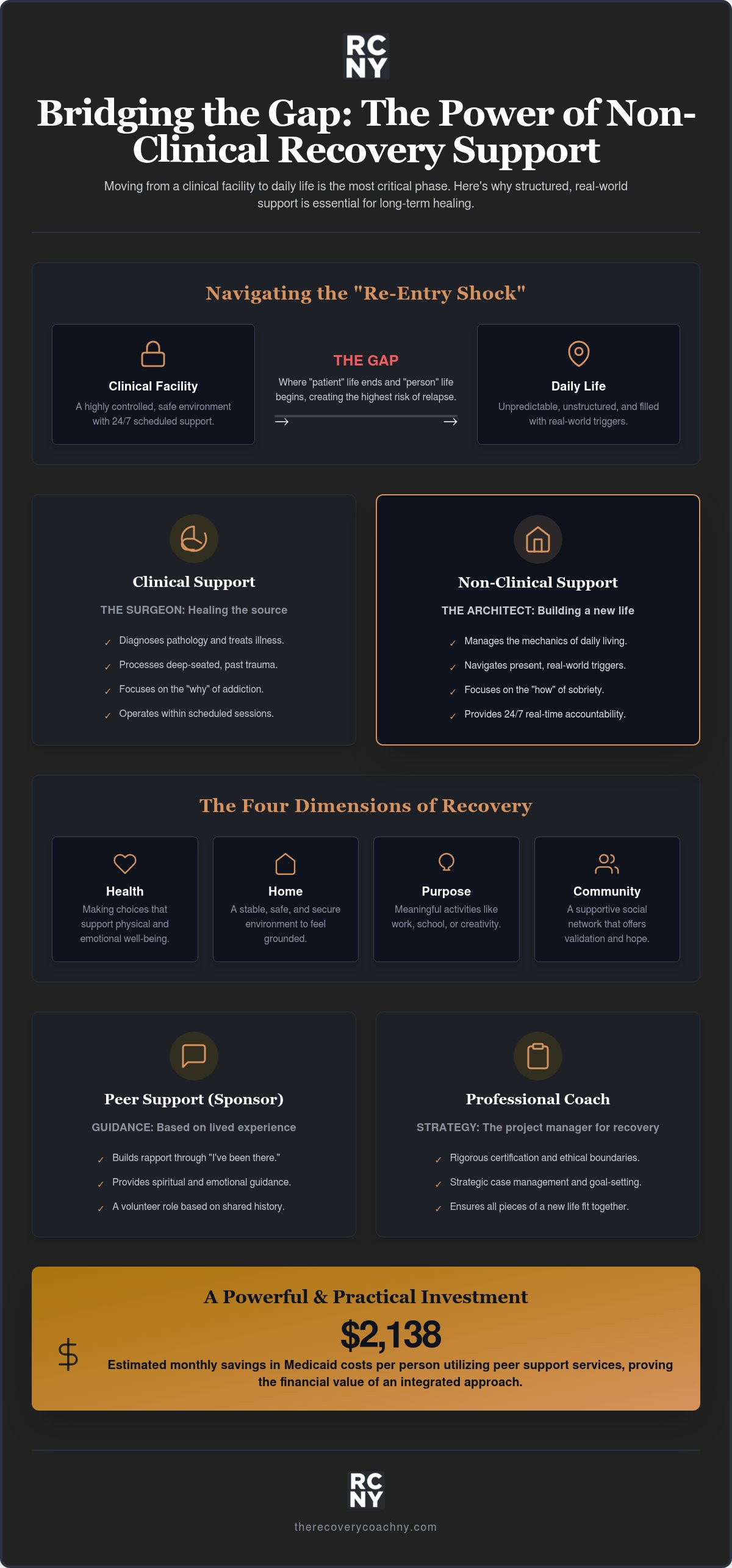
Why does the transition from a highly controlled clinical facility back to your own living room feel like stepping off a cliff? You've completed the intensive programs and followed the protocols, yet the "re-entry shock" of daily life remains the most dangerous phase of the journey. It's a common struggle; you feel like a patient while the world expects you to be a person again. This gap is exactly why non-clinical recovery support has become the essential scaffolding for long-term healing.
We understand that the hours between therapy sessions are often where the most critical decisions are made. You deserve a recovery that doesn't just stop the problem but builds a life you actually want to live. In this guide, we'll discover how professional accountability and structured daily routines provide the "project management" your sobriety needs. We'll explore how shifting from a clinical model to a human-centric, supportive framework creates a sustainable foundation, giving your family the peace of mind they've been searching for. Recent data suggests that peer support services can save approximately $2,138 in monthly Medicaid costs. This proves that an integrated approach is a practical, powerful investment in your future.
Key Takeaways
Understand how non-clinical recovery support bridges the gap between intensive medical treatment and the complex realities of daily life.
Learn why the traditional clinical hour often fails to address 24/7 real-world triggers and how to build a more robust, personalized safety net.
Identify the specific risks associated with the first 90 days of sobriety and how structured accountability helps you successfully manage re-entry shock.
Discover practical applications for professional support, including safe transport and sober companions, to ensure a secure transition during high-risk life events.
Gain clarity on how to find a certified coach who functions as a methodical strategist for your long-term healing and your family's peace of mind.
Table of Contents
Defining Non-Clinical Recovery Support: Beyond the Doctor's Office
You've likely spent weeks or months in a clinical environment where every hour is scheduled and every risk is mitigated. But what happens when the hospital doors close and the safety of the facility fades into the background? This is where the real work of living begins. Non-clinical recovery support is the professional, peer-led, or coaching-driven assistance that exists entirely outside the traditional medical setting. It isn't a replacement for medicine or therapy. Instead, non-clinical recovery support is the structural scaffolding that supports an individual’s life between clinical sessions.
It's a common misconception that "non-clinical" implies a lack of skill or professional rigor. On the contrary, this work requires a highly specialized methodology focused on the "here and now" rather than the "then and there." While a therapist might help you unpack the trauma of your past, a recovery coach helps you navigate the grocery store, the boardroom, or the family dinner where triggers live. It's about movement. It's about rebuilding. We focus on the practical architecture of a new life, ensuring that social integration and real-time accountability aren't just concepts, but daily realities. This support doesn't stop at the office door; it travels with you into the world.
The Four Dimensions of Recovery
Recovery is more than just the absence of a substance; it's the presence of a foundation. We look at four specific pillars to ensure long-term stability. First, health involves managing symptoms and making informed choices that support physical and emotional well-being, often complemented by wellness services from West Vital Peptides LLC to aid physical recovery. Second, home requires a stable, safe environment where you feel secure and grounded. Third, purpose gives you a reason to wake up, whether through work, school, or creative pursuits. Finally, community provides the social network that validates your journey and offers hope when yours feels thin. Without these four dimensions, even the best clinical treatment can struggle to take root.
Peer-Led vs. Professional Support
Trust often begins with the phrase, "I've been where you are." Lived experience allows for an immediate rapport that clinical credentials alone cannot always bridge. This shared history creates a unique sense of safety and mutual understanding. However, there is a distinct difference between a volunteer 12-step sponsor and a Certified Professional Coach. Recovery coaching involves certification, clear ethical boundaries, and a strategic approach to case management that volunteers aren't equipped to provide. While a sponsor provides spiritual guidance, a professional coach acts as a project manager for your recovery. They ensure that every piece of your new life fits together securely, maintaining a high-touch, elite level of accountability that private healing requires.
Clinical vs. Non-Clinical Support: Understanding the Difference
"If I have a therapist, why do I need a coach?" This is the question we hear most often from families and individuals alike. You've invested in the doctors. You've committed to the therapy. You've followed the prescriptions. It's only logical to wonder why another layer of care is necessary. However, clinical and non-clinical roles serve entirely different functions. While a therapist focuses on diagnosing pathology and processing deep-seated trauma, non-clinical recovery support focuses on the immediate mechanics of daily living. One looks backward to heal the source; the other looks forward to manage the symptoms of a life in transition.
Think of your clinical team as the surgeons who repair an injury. Think of your coach as the architect who helps you build the house you'll actually live in. Investing in long-term recovery requires more than just clinical insight; it requires environmental action. Coaches act as the "eyes and ears" for your clinical team, observing behaviors and triggers that simply never surface during a scheduled appointment. This collaboration ensures that your doctor isn't just relying on what you remember to tell them once a week. It provides a 360-degree view of your progress.
The Clinical Hour vs. Real-World Triggers
Most relapses don't happen in a doctor’s office at 2:00 PM on a Tuesday. They happen at 2:00 AM on a Saturday, or during a high-pressure work trip where the minibar is only a few feet away. The "Clinical Hour" is 50 minutes spent in a safe, sterile environment. The "Recovery Life" is 24/7 exposure to a world that hasn't stopped spinning just because you're sober. Coaching is inherently active. We don't wait for you to come to us; we meet you at cafes, in your home, or at your office. This proximity allows for real-time accountability and case management that bridges the gap between your various medical providers.
A Collaborative Model of Care
It's vital to view this as a partnership. non-clinical recovery support is a bridge, not a replacement. When a coach can communicate directly with your psychiatrist or therapist, the "chaos" that often surrounds early sobriety begins to settle. This single point of coordination relieves the family of the burden of being the "recovery police." Instead of monitoring your every move, they can return to being your spouse, parent, or child. If you're looking for a structured way to integrate these layers of care, exploring professional recovery coaching can provide the strategic oversight your journey needs.
Why Non-Clinical Support Is Critical During Re-Entry
Leaving a residential facility is often more traumatic than entering one. You've spent weeks or months in a curated environment where every meal is prepared, every schedule is set, and every trigger is removed. Then, the doors open. You return to a world that hasn't changed, even though you have. The mail is piled up; the old social circles are calling; the "rehab bubble" has burst. This is re-entry shock. It's the primary reason the first 90 days are widely recognized by professionals as the most vulnerable window for relapse. Non-clinical recovery support provides the bridge that helps you translate theoretical lessons into practical, messy, real-world action.
Without a transition plan, the risk of a "revolving door" experience becomes high. Clinical treatment provides the tools, but it doesn't always provide the supervision required to use them in the heat of a crisis. This is where a coach becomes the project manager of your new life. We ensure that the vacuum left by the substance is filled with healthy, sustainable routines before old habits have a chance to rush back in. Recent data highlights the economic and personal value of this approach; an analysis in New York found that peer support services resulted in Medicaid savings of approximately $2,138 per enrolled month. This investment in non-clinical recovery support isn't just about safety; it's about the efficient rebuilding of a life.
Breaking the Cycle of Chronic Relapse
Why do some individuals return to treatment five or six times? It's rarely a lack of desire or willpower. Instead, it's often the "missing link" of structural accountability. Many people struggle with executive function after long-term substance use. Simple tasks like managing a calendar, attending appointments, or grocery shopping can feel overwhelming. Executive function coaching helps rebuild these cognitive muscles. By utilizing accountability tools such as scheduled check-ins and professional drug testing, we build trust back into the family system. This transparency allows you to prove your progress through actions rather than just words.
The Family’s Role in Sustainable Recovery
When a loved one returns home, the family often defaults to becoming the "recovery police." They check receipts, monitor phone calls, and wait for the other shoe to drop. This dynamic is exhausting for everyone and often triggers the very resentment that leads back to use. Our goal is to move the family from crisis management to supported independence. Through family consulting, we help end the enabling cycle and establish firm, compassionate boundaries. We provide a calm in the storm for parents and spouses, allowing them to step out of the monitor role and back into their roles as supportive partners and family members.
When the recovery process involves parents, the strain on the partnership can be significant. Specialized support from De Relatiespecialist can help couples with children navigate these relational challenges and rebuild a healthy, supportive home environment.
Practical Applications: When to Use Non-Clinical Support
Recovery doesn't happen in a vacuum. It happens in airport terminals, boardroom meetings, and family weddings. While clinical therapy provides the internal tools for healing, non-clinical recovery support provides the external logistics to keep that healing intact during high-stakes moments. We often see the most significant breakthroughs not in an office, but during the successful navigation of a real-world challenge that previously felt impossible. This support is about movement and safety, ensuring that your sobriety isn't a fragile state, but a mobile foundation that travels with you.
One of the most critical applications is Safe Transport. The journey from your home to a treatment facility is a window of extreme vulnerability. Professional transport ensures a secure, compassionate transition, removing the opportunity for last-minute diversions or "one last time" mistakes. Similarly, Sober Companions provide 24/7 live-in support during high-risk periods. Whether you're returning home from rehab or facing a major life transition, having a professional by your side provides a level of real-time accountability that clinical care cannot match. For those who must travel, professional escorts manage the triggers of international business trips or family vacations, turning a potential crisis into a managed experience.
High-Risk Events and Social Navigation
How do you handle a champagne toast at your sister's wedding? How do you manage the "after-parties" in the music or film industry? For musicians, actors, and high-level executives, the social demands of their careers are often at odds with their recovery goals. A sober companion acts as a strategic partner in these settings. They provide a discreet exit strategy and a constant, grounding presence. This support extends to legal proceedings as well. Navigating court dates or custody hearings is inherently stressful. Having professional support during these moments ensures you remain composed, present, and focused on your long-term stability.
Academic and Professional Re-Integration
Returning to a college campus or a high-pressure career after treatment can feel like walking back into a minefield. Students often face a culture where substance use is normalized, while professionals return to the same stressors that contributed to their initial struggle. Academic coaching and executive function support help you rebuild your daily routine from the ground up. We focus on "sober life skills" that traditional education often misses, such as time management, stress regulation, and boundary setting. If you're ready to build a customized plan for your transition, our team provides the professional recovery coaching and accountability you need to succeed.
Finding the Right Level of Professional Support
When you begin the search for non-clinical recovery support, the distinction between a volunteer and a professional strategist is paramount. You aren't just looking for someone who has successfully navigated their own sobriety; you're looking for an expert who understands the complex architecture of behavioral health. A professional coach should possess verified credentials, a strict ethical framework, and a proven track record of successful case coordination. In an industry that is rapidly professionalizing, it's vital to choose leaders who stay ahead of emerging standards, such as the certification mandates being adopted in states like Colorado and Washington for 2026.
The most effective support is often the most discreet. While public programs and helplines provide a vital service, they frequently lack the high-touch responsiveness required for multi-layered crises or high-profile lifestyles. Private-pay models allow for a level of 24/7 availability and customized care that traditional insurance-based billing simply cannot sustain. This ensures that your support system is proactive rather than reactive. Instead of waiting for an available slot in a generic program, you receive a tailored framework designed specifically for your career, your family dynamics, and your personal goals. At The Recovery Coach NY, we position ourselves as the gold standard for this level of elite, private care coordination.
The Value of Deep Experience
Experience is the only teacher that cannot be bypassed or fast-tracked. Cindy Feinberg’s 35+ years in the field provide a unique level of insight that only comes from navigating thousands of unique recovery journeys. As a "trusted insider," she understands the global landscape of providers and facilities, ensuring you have access to the highest quality resources available. A seasoned coach remains unruffled by complex, multi-layered crises, providing the steady, experienced hope that families need when they feel they've reached their limit. This level of authority allows us to function as your project manager, ensuring every clinical and non-clinical piece of the puzzle fits together perfectly.
Next Steps: Taking the First Action
Initiating a consultation is the first step toward moving from a state of distress to a state of organized relief. Whether you're seeking help for yourself or a loved one, the process is designed to be seamless and entirely confidential. Within the first 24 hours of engagement, we begin the vital work of assessment and strategy development. We don't just offer advice; we implement a structured system of care that provides immediate stability for the individual and peace of mind for the family. You don't have to manage this transition in isolation. Contact The Recovery Coach NY for a confidential consultation and begin building the sustainable foundation your long-term healing deserves.
Building Your Foundation for Lasting Change
You've already taken the hardest step by committing to change. Now, it's about ensuring that change has the room to breathe and grow in the real world. We've seen how clinical treatment provides the essential medical tools. Yet, it's the daily structure and real-time accountability that turn a fragile sobriety into a permanent lifestyle. By integrating non-clinical recovery support into your long-term plan, you create a safety net that travels with you through every boardroom meeting, family gathering, and quiet evening at home.
Led by Cindy Feinberg, CPC, CAI, who brings over 35 years of experience to the field, our team acts as the methodical strategists for your healing. We provide 24/7 crisis intervention and sober companions to navigate the most difficult transitions, alongside holistic case management that allows your family to heal together. You don't have to carry the burden of coordination alone. We are here to be the calm in your storm, providing the practical architecture for a future you can be proud of. It's time to move from surviving to truly living.
Begin your personalized journey with The Recovery Coach NY
Frequently Asked Questions
Is non-clinical recovery support covered by insurance?
Private non-clinical recovery support is typically a private-pay service rather than an insurance-based one. While there is a growing national trend toward reimbursement, such as Michigan's plan to cover peer recovery coaches in hospitals by October 1, 2026, elite private coaching focuses on enhanced discretion and immediate 24/7 responsiveness. This model allows for a level of personalized care that traditional insurance protocols don't always accommodate.
How does a recovery coach differ from a sponsor in AA?
A recovery coach is a certified professional, while a sponsor is a volunteer peer mentor within a 12-step program. While both offer support, a coach operates within a professional framework that includes ethical boundaries, case management, and strategic planning. We focus on the practical architecture of your daily life, whereas a sponsor primarily guides you through the spiritual steps of a specific program.
Can a recovery coach help if my loved one refuses to go to rehab?
Yes, professional intervention and emergency services are designed for exactly this situation. We meet individuals where they are, often utilizing a non-confrontational approach to build trust and navigate the barriers to care. By providing a steady, experienced presence, we can help facilitate a transition to treatment or implement a safe at-home support structure when traditional rehab is initially rejected.
What exactly does a sober companion do all day?
A sober companion provides a 24/7 safety net by living and traveling with you to manage real-world triggers in real-time. They don't just watch you; they help you navigate social events, manage daily routines, and provide professional accountability during high-risk windows. Whether it's an international business trip or the first week home from a facility, they ensure your environment remains conducive to healing.
Is recovery coaching only for drug and alcohol addiction?
No, our support extends to a wide range of life challenges, including mental health issues, executive function struggles, and academic hurdles. We provide specialized coaching for psychedelic integration and scholastic support for students returning to campus. Our focus is on the "whole person" and the systems surrounding them, helping anyone who needs a methodical strategist to rebuild their daily functioning.
How long does professional non-clinical support usually last?
The duration of support is entirely customized to the needs of the individual and their family. While the first 90 days are a critical window for establishing stability, many clients benefit from longer-term non-clinical recovery support to navigate major life transitions. We move from intensive, high-touch involvement toward a model of supported independence as your new routines become a solid foundation.
Can a recovery coach work with my existing therapist or doctor?
Absolutely, we function as a collaborative partner to your clinical team. We act as the "eyes and ears" for your therapist or psychiatrist, providing them with real-world behavioral data that rarely surfaces in a 50-minute office session. This integrated approach ensures that all your providers are working in harmony, creating a seamless pulse of care throughout your journey.
Do you provide support for mental health issues without addiction?
Yes, we offer dedicated mental health support and coaching that focuses on daily functioning and emotional regulation. Many of our clients struggle with primary mental health diagnoses or executive function challenges that require a practical architect to help manage routines. You don't need a substance use diagnosis to benefit from the structured accountability and compassionate guidance we provide.