Private Addiction Crisis Support: A Concierge Guide to Immediate Recovery Intervention (2026)

You've spent another night staring at the phone, waiting for a call you dread while rehearsing a conversation you've already had a dozen times. You've tried the pleading. You've tried the silence. You've likely tried searching for answers in a fragmented healthcare system only to find yourself back at the beginning. When a loved one is spiraling, the need for private addiction crisis support becomes more than a clinical requirement; it becomes a vital lifeline for your family's survival. You deserve a solution that honors your privacy while moving with the quiet urgency this moment demands.
It's exhausting to manage the fear of public exposure alongside the constant anxiety over a loved one's physical safety. You know that a standard emergency room visit or a generic hotline cannot provide the sophisticated, high-touch management your situation requires. This guide will show you how concierge crisis support bridges the critical gap between immediate stabilization and lasting recovery success. We will walk through the mechanics of discreet intervention, the logistics of safe professional transport, and the creation of a long-term plan that finally involves the healing of the whole family.
Table of Contents
What is Private Addiction Crisis Support?
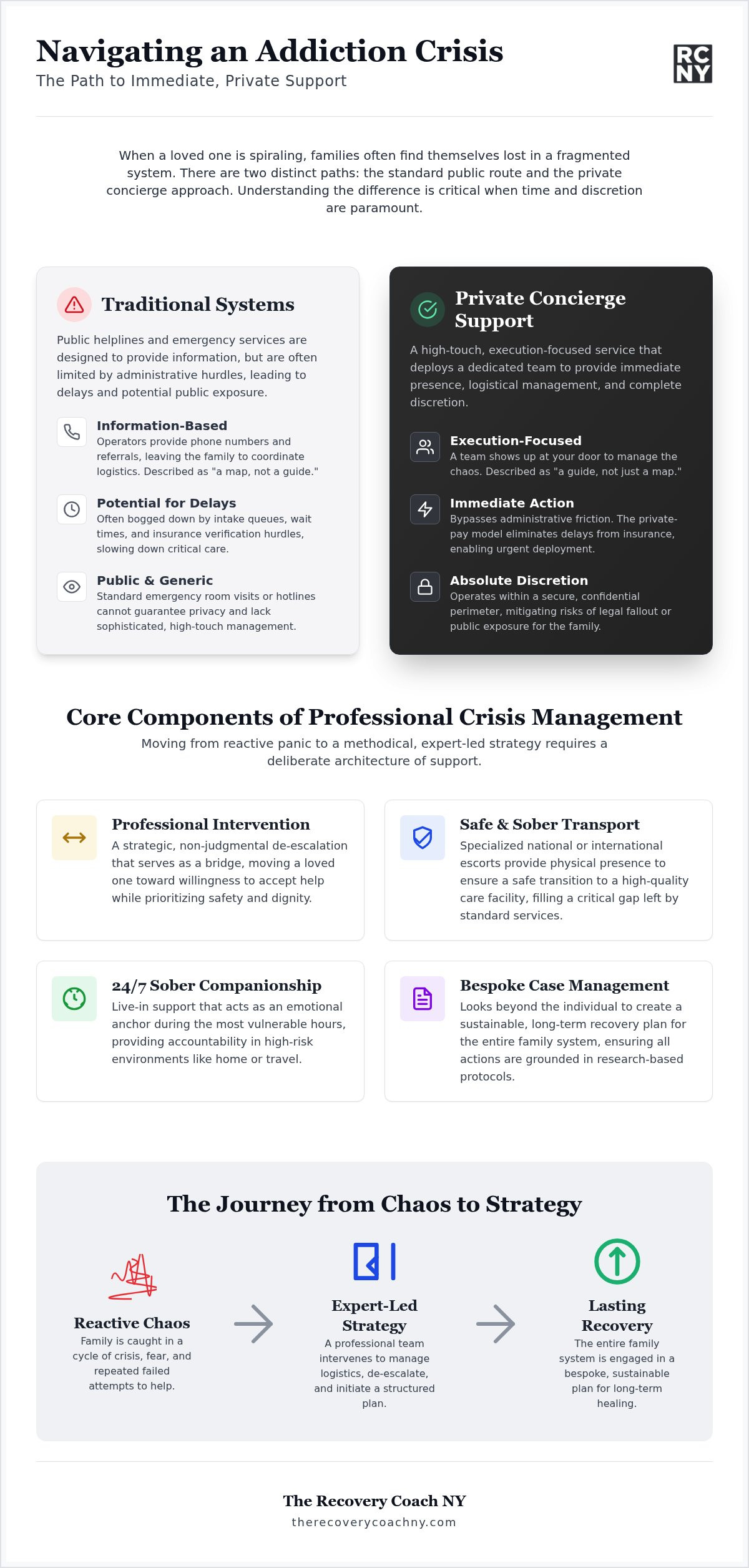
When the phone rings at 3:00 AM, and the voice on the other end is unrecognizable, your world shrinks to a single, desperate question: What do I do right now? Most families start with a search for help, only to find themselves lost in a maze of automated directories and clinical referrals. Private addiction crisis support is a high-touch, execution-focused alternative to traditional helplines. It is a concierge-level service designed to provide immediate, physical presence and logistical management when a situation has moved beyond the family's ability to cope.
At its core, this support isn't about giving you a list of facilities to call. It's about deploying a dedicated team to manage the chaos. Professional Intervention (counseling) serves as the initial bridge, moving a loved one from a state of denial or acute danger toward a willingness to accept help. This isn't a clinical diagnosis; it's a strategic, non-judgmental de-escalation that prioritizes safety and dignity above all else.
For high-profile or high-net-worth families, the standard public response systems often carry too much risk. The fear of legal fallout or public exposure can lead to a dangerous paralysis. Private support operates with a level of discretion that public institutions simply cannot match, ensuring that the crisis is managed within a secure, confidential perimeter.
The Difference Between Public Helplines and Private Concierge Care
Public helplines are designed to provide information. They are vital resources, but they are limited by their own administrative structures. A hotline operator gives you a phone number; a private crisis management team gives you the people who show up at your door. This is the distinction between a map and a guide. While public systems are often bogged down by wait times and insurance verification hurdles, private addiction crisis support moves with quiet urgency. There are no intake queues or bureaucratic delays. When the situation is volatile, the ability to bypass administrative friction can be the difference between a successful transition and a tragic escalation.
When to Move Beyond a 24/7 Hotline
A hotline is a starting point, but it isn't a safety net. You'll know it's time to move toward private concierge care when the "chaos" has become a daily routine rather than an isolated event. If you find yourself worried about the physical safety of your loved one during transport, or if previous attempts to help have resulted in repeated failure, you need a higher level of accountability. Insurance-based emergency services often lack the resources to provide 24/7 sober companions or specialized international escorts. Private support fills this gap by providing the physical presence necessary to ensure a safe transition to a high-quality care facility, regardless of the distance or complexity involved.
Core Components of Professional Crisis Intervention and Case Management
Effective recovery doesn't happen by accident. It requires a deliberate architecture of support that extends far beyond a simple referral. While talking through a crisis is a necessary start, private addiction crisis support focuses on the physical and logistical execution of a recovery plan. This involves orchestrating a safe, respectful turning point that honors the individual's dignity while addressing the reality of the situation. It's about moving from reactive panic to a methodical, expert-led strategy.
A professional intervention is not a "tough love" ambush. It's a highly managed event where a specialist guides the family system toward a unified goal. This coordination extends to mental health, ensuring that dual diagnoses are recognized and integrated into the immediate plan. By following established Principles of Drug Addiction Treatment, we ensure that every action is grounded in research-based safety protocols rather than reactive emotion. We look at the whole person, not just the substance use, to build a foundation that can actually hold weight.
24/7 Sober Companionship and Live-In Support
The most vulnerable hours are often the ones between treatment sessions or immediately following a crisis. A sober companion provides 24/7 live-in support, acting as an emotional anchor in high-risk environments like the family home or during essential travel. They don't just "watch" the individual; they coach them through the minute-to-minute triggers that lead to relapse. This constant accountability provides the family with the first night of restful sleep they've had in months. It's a shift from supervision to active, real-time rebuilding of daily habits.
Safe Transport and Professional Escort Services
The transition from home to a care facility is the highest risk period for flight or relapse. Anxiety is at its peak. The individual may feel a sudden urge to disappear before reaching safety. Professional safe transport protocols manage every detail of domestic or international travel. This includes handling luggage, securing legal documents, and managing medication schedules. We remove the burden of logistics from the family, ensuring the transition is seamless and secure. For those needing immediate logistical help, exploring specialized recovery services can provide the bridge needed to reach a higher level of care safely.
Evaluating Private Pay Recovery Support vs. Insurance-Based Options
You've likely already discovered that the standard insurance model is built for clinical stabilization, not for the high-touch navigation your family actually needs. This creates what we call the "Insurance Gap." While medical detox and residential stays are often covered, the vital tools that ensure long-term success, such as 24/7 companions and recovery coaches, are frequently excluded. Choosing private addiction crisis support allows you to bypass these clinical limitations. It places the focus back on the individual rather than the billing code.
Discretion is often the primary driver for families seeking this level of care. In a private-pay model, there is no medical record trail that could potentially impact a loved one's professional standing or legal status. You gain a level of privacy that public systems cannot guarantee. While following Mayo Clinic's guide to addiction intervention can help you prepare for the initial conversation, the actual execution of a concierge plan is tailored to your specific reality. There is no clinical bureaucracy to slow down the response. You get the help you need when you need it, not when an adjuster approves it.
Accountability is the bedrock of this direct relationship. When you hire a private team, they are accountable to you and your family system. This creates a transparent, highly responsive environment where the strategy can shift in real time as the situation evolves. It's about movement. It's about rebuilding. It's about having a seasoned expert who is a fierce advocate for your loved one's future.
The Value of Non-Clinical Recovery Coaching
Recovery coaching supplements traditional therapy by focusing on the practical "how-to" of daily life. While a therapist explores the "why" of addiction, a coach works on executive function and accountability in the present moment. This is especially vital in professional or creative environments where the individual must maintain their responsibilities while navigating early sobriety. We integrate these support systems directly into the individual's routine, providing a solid foundation for daily functioning that clinical settings often overlook.
Long-Term Case Management vs. Short-Term Stabilization
The first 90 days after a crisis are often called the "danger zone." This is when the initial resolve begins to fade, and the old triggers resurface. Case management mitigates this risk by providing a single point of contact who coordinates between doctors, therapists, and legal counsel. We don't just stabilize the crisis; we manage the transition back into a full, productive life. This sustainable approach ensures that the family isn't just surviving the storm but is actively building a system that prevents the next one from ever forming.
Immediate Action Steps: How Families Can Navigate an Addiction Crisis
The first twenty-four hours of a crisis are often the most volatile. You feel the pressure to act, yet the fear of making the wrong move can lead to a dangerous paralysis. The most effective way to pause the chaos is to move from reactive emotion to a structured, professional consultation. Securing the environment doesn't mean solving the addiction overnight; it means creating a perimeter of safety where logic can return to the conversation. This is where private addiction crisis support becomes a functional necessity rather than a luxury.
Once the immediate environment is stabilized, the next step involves identifying the specific tools required for the transition. Does the situation demand a formal intervention to break through denial? Is the individual in need of a 24/7 sober companion to prevent a high-risk relapse? Or is the priority a safe, professional transport to a treatment facility? By assembling a recovery team led by a seasoned case manager, you shift the burden of logistics away from the family. This allows you to return to your role as a spouse, parent, or sibling while an expert executes the stabilization plan with professional oversight.
Preparing for a Professional Intervention
A successful intervention is rarely a "surprise" ambush; it's a meticulously structured event. Unlike the chaotic confrontations often depicted in media, a professional intervention focuses on respect and clear communication. The family’s role is to provide a unified front of love and firm boundaries, guided by a specialist who manages the emotional temperature of the room. Industry data historically suggests that up to 90% of professionally led interventions result in the individual agreeing to accept help immediately. This high success rate is due to the strategic preparation that happens long before the actual meeting takes place.
Establishing Safe Boundaries and Accountability
Rebuilding a life requires more than just stopping a behavior; it requires the restoration of daily life skills. One of the most difficult shifts for families is learning how to stop enabling while maintaining a supportive connection. We implement executive function coaching to help the individual manage the practicalities of a sober life, from scheduling to financial accountability. This process often begins with a safe transport plan for the first 48 hours, ensuring that the individual is never left without an anchor during the peak of their anxiety. If you are ready to move from crisis to a structured path forward, you can contact our team for immediate intervention support to begin the stabilization process today.
The final step in this immediate roadmap is the transition into a long-term coaching framework. Recovery isn't a destination reached at the end of a 30-day program; it's a daily practice that requires ongoing support. By establishing these accountability systems early, you create a foundation that can withstand the inevitable challenges of early sobriety.
Strategic Crisis Management with The Recovery Coach NY
Navigating a multi-layered crisis requires more than just empathy; it requires a strategic architect who has seen every possible permutation of the recovery landscape. The Cindy Feinberg Approach is built on over 35 years of experience managing the most complex cases worldwide. We understand that no two families are identical, which means no two recovery plans should be. Our bespoke case management is designed to meet you exactly where you are, providing a tailored framework that addresses the unique dynamics of your situation. This isn't just about cessation. It's about movement toward a sustainable, high-functioning future.
Our global reach allows us to provide private addiction crisis support regardless of your physical location. Whether you require on-site intervention or virtual coaching, our team moves with quiet urgency to stabilize the situation, providing support wherever it's needed. We offer specialized support through programs like The Elder Coach NY, as well as dedicated services for creatives and high-profile professionals who face unique public-facing pressures. By integrating mental health coordination with executive function coaching, we ensure that every aspect of the individual's life is supported during the rebuilding process.
Why High-Net-Worth Families Trust Our Discretion
For families in the public eye, the greatest barrier to seeking help is often the fear of exposure. We function as a trusted insider in the global recovery network, maintaining a secure perimeter around your family's privacy. Our safe transport and sober companion services are designed for international business and travel, allowing a loved one to maintain their professional reputation while receiving intensive care. We manage the logistics of international travel with 2026 availability for sober escort services, ensuring that even the most complex global itineraries are handled with professional precision. You don't have to choose between your career and your family's health.
Getting Started: The Path from Crisis to Calm
The journey begins with a comprehensive initial assessment. We take the time to understand the specific dynamics of your crisis, identifying the triggers and systems that have led to the current state of distress. Once the plan is established, we offer immediate activation, deploying companions or interventionists nationwide to provide the physical presence your situation requires. This isn't a passive referral; it's an active, high-touch partnership that leads your family from a state of crisis to a sense of organized relief. To begin this transition, speak with a Certified Recovery Professional Today and let us help you build a solid foundation for the future.
Restoring Peace to Your Family System
The transition from a state of reactive chaos to one of organized relief begins with a single, decisive step. Choosing private addiction crisis support offers the discretion and physical presence that clinical hotlines simply cannot provide. By integrating professional intervention with specialized safe transport and 24/7 sober companions, we ensure that your loved one moves securely toward a sustainable future. This isn't just about managing a temporary emergency; it's about building a solid foundation for the whole family.
Led by Cindy Feinberg, CPC, CAI, with over 35 years of expertise, our team functions as your trusted guide through the most complex recovery landscapes. We provide global availability for high-touch care, ensuring that professional advocacy is always within reach regardless of your location. You don't have to navigate this storm alone. When you are ready to move beyond the exhaustion of failed attempts, we are here to provide the steady hand you need. Secure Immediate, Discreet Crisis Support Now and begin the journey back to a life defined by clarity and connection. There is hope, and a practical path forward is waiting for you.
Frequently Asked Questions
What is the difference between an interventionist and a recovery coach?
An interventionist manages the initial crisis and the turning point where the individual agrees to accept help. A recovery coach focuses on the long-term maintenance of sobriety and daily life skills. Think of the interventionist as the navigator who steers you through the storm, while the coach is the architect who helps you rebuild on solid ground. Both roles are essential for a seamless transition from emergency stabilization to daily accountability.
Can you provide a sober companion for international travel on short notice?
Yes, we specialize in deploying professional companions for international travel, often with very little lead time. Our team is prepared for global movement, managing the logistical complexities of cross-border travel while providing constant emotional anchoring. Whether you're traveling for business or moving a loved one to a facility abroad, we provide the physical presence necessary to ensure the journey remains safe and secure, regardless of the destination.
Does private addiction crisis support include mental health case management?
Private addiction crisis support integrates comprehensive mental health case management to address the whole person rather than just the substance use. We coordinate with psychiatrists, therapists, and medical doctors to ensure that dual diagnoses and complex clinical needs are managed within a single, cohesive plan. This holistic approach prevents the fragmentation of care that often occurs in traditional systems, providing a unified strategy for both the individual and their family.
What happens if my loved one refuses to go to treatment during an intervention?
If an individual refuses treatment, we pivot to a pre-negotiated family boundary plan that prioritizes the health of the family system. While the goal is immediate placement, a refusal isn't a failure; it's a shift in strategy. We help you implement firm, loving boundaries that stop enabling behaviors. This often creates the necessary pressure for the individual to accept help shortly after the initial meeting, as the old safety net of chaos is removed.
How long does a sober companion typically stay with a client?
The duration of companionship is entirely bespoke, ranging from a few days of acute stabilization to several months of live-in support. We tailor the intensity of the service to the individual's specific risk factors and environment. Some clients require 24/7 presence during the high-risk 90-day danger zone, while others transition to part-time coaching once they've rebuilt the daily routines and executive function skills necessary for independent living.
Is private recovery support more discreet than insurance-based programs?
Private addiction crisis support is significantly more discreet because it bypasses the clinical billing and insurance documentation that leaves a permanent medical trail. There are no diagnostic codes or employer-linked records to worry about. For high-profile professionals, this level of privacy is a vital safeguard for their reputation. You receive intensive, professional care within a secure, confidential perimeter that honors your need for absolute anonymity during a sensitive family crisis.
Do you offer support for families as well as the individual in recovery?
Yes, we believe that recovery is a system-wide process that must involve the entire family to be sustainable. We provide specific coaching and support for family members to help them navigate their own exhaustion and fear. By addressing the dynamics of the whole household, we help you rebuild trust and establish healthy communication patterns. This ensures that when your loved one returns to daily life, the environment is supportive and grounded in accountability.
What is safe transport to rehab and why is it necessary?
Safe transport is a professional escort service that manages every logistical detail of the journey from home to a treatment facility. It's necessary because the transition period is the highest risk time for flight or relapse due to peak anxiety. We handle luggage, medication, and travel documents, removing the burden of conflict from the family. This ensures the individual reaches their destination securely and respectfully, maintaining the momentum created during the initial intervention.