The Private Pay Recovery Coach: A 2026 Guide to Concierge Healing and Discretion
- Cindy Feinberg, CPC, CAI

- Jul 7
- 12 min read
Updated: 4 days ago
What if the very insurance policy meant to protect your health is actually the barrier standing between you and a permanent recovery? You've likely experienced the frustration of a system that treats your personal crisis like a series of billable codes and standardized checklists. You need more than a generic protocol. You need a partner who understands that a high-functioning life demands a higher level of privacy and precision. Partnering with a private pay recovery coach ensures your healing remains your own, shielded from the bureaucratic oversight that often triggers the revolving door of short-term rehab success followed by immediate relapse.
We understand the quiet urgency of this moment and the fear of professional repercussions that keeps many from seeking the help they deserve. This 2026 guide reveals how a private pay model provides the specialized discretion, 24/7 availability, and bespoke care coordination that insurance-based programs are not designed to offer. We'll explore how a coordinated recovery plan involves the whole family and creates a solid foundation for long-term, sustainable sobriety that fits seamlessly into your daily life.
Table of Contents
Understanding the Private Pay Recovery Coach Model
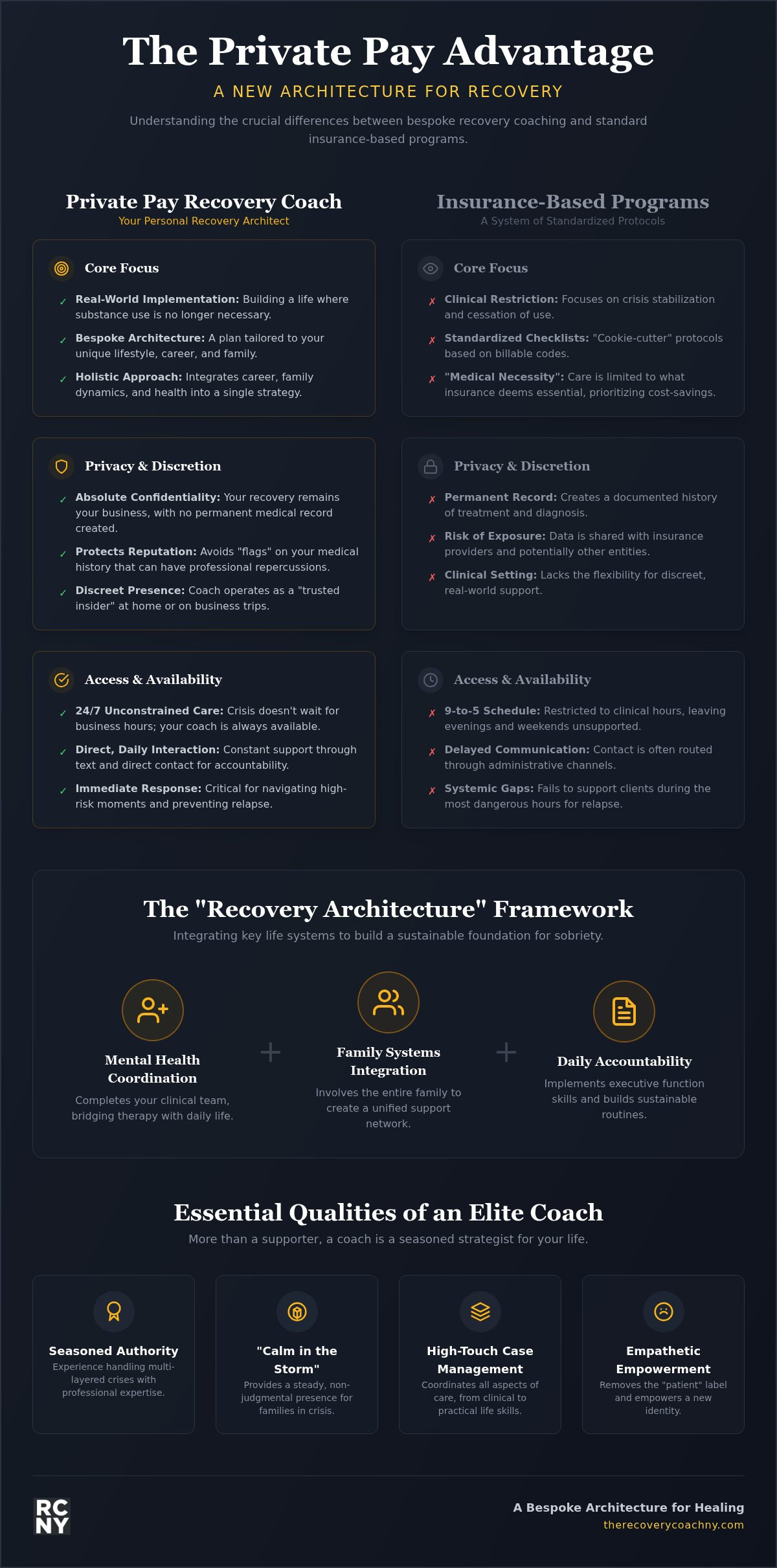
You may feel like you're drowning in a sea of clinical labels and insurance codes. It’s exhausting to navigate a system that treats your life like a series of checkboxes. A private pay recovery coach functions as a high-level recovery architect, stepping into the "storm" of your current reality to help you build something stable. This model represents a fundamental shift from clinical treatment to real-world implementation. While traditional rehab focuses on the cessation of use, we focus on the creation of a life where use is no longer necessary. Recovery coaching provides the bridge between the safety of a facility and the complexities of your home, office, and community.
By bypassing insurance, we remove the "middleman" who often prioritizes cost-savings over your long-term success. Insurance companies require a diagnosis and a rigid adherence to clinical protocols that don't always fit a high-functioning life. The private pay model allows for a non-judgmental, "whole person" approach. We look at your career, your family dynamics, and your physical health as interconnected pieces of a single puzzle. This isn't just about stopping a behavior; it's about navigating a new path forward with a steady, experienced hand at your side. This architecture is built on accountability, not just abstinence.
The Non-Clinical Advantage
Building accountability through direct, daily interaction and text support.
Implementing executive function strategies to manage professional and academic demands.
Creating a coordinated recovery plan that involves the entire family system.
Why Discretion is the Pillar of Private Pay
For the executive, the high-profile student, or the family with a legacy to protect, privacy isn't a luxury; it's a necessity. Traditional insurance-based support creates a permanent record of your struggle, often attaching a "flag" to your medical history that can have professional repercussions for years. A private pay recovery coach offers a layer of protection that clinical institutions cannot match. We operate as "trusted insiders" within your circle. Whether we are accompanying you on a business trip or supporting you at home, our presence is discreet and professional. Your recovery remains your business, allowing you to heal without the fear of public exposure or a compromised career. This level of concierge care ensures your private life stays private.
Private Pay vs. Insurance-Based Support: A Detailed Comparison
Insurance companies operate on a "medical necessity" framework. This usually means they only pay for the bare minimum required to stabilize a crisis. It's a fundamental conflict of interest. They prioritize cost-savings; you prioritize a life reclaimed. When you hire a private pay recovery coach, the focus shifts from what the insurance adjuster will approve to what you actually need to thrive. The standard 28-day model used by many insurance-backed programs often fails high-functioning individuals because it doesn't account for the complex professional and personal responsibilities you must return to immediately. You don't need a cookie-cutter protocol; you need a bespoke architecture that respects your unique lifestyle.
There's also a significant difference in the level of professional expertise. While insurance might cover a "peer advocate," these roles are often limited in scope and training. A professional coach is a seasoned strategist with the experience to handle multi-layered crises. In New York, for example, certification standards for peer advocates were updated in July 2026 to require more ethics and training, yet these entry-level roles still don't match the holistic case management offered by a private specialist. Private pay removes the barriers to high-level care, ensuring you aren't just another number in a crowded system.
Access and Availability Differences
Crisis doesn't wait for business hours. The clinical model is usually restricted to a 9-to-5 schedule, leaving families to navigate the most dangerous hours, like a 2 AM relapse or a weekend emergency, entirely alone. A private pay model changes this dynamic by providing 24/7 accessibility. Through the use of sober companions, support becomes a round-the-clock reality. This includes safe transport and travel escorts for business trips or family events, ensuring your environment remains secure regardless of the ZIP code. If you're facing an immediate challenge, you can explore specialized intervention services that provide the steady, experienced hand needed during a transition.
The Quality of Professional Engagement
High-quality care requires time and focus. Insurance-based providers often carry heavy caseloads, which dilutes the attention each person receives. Private coaches maintain intentionally low caseloads to ensure they can act as a true "calm in the storm." This allows them to coordinate seamlessly with your hand-picked team of doctors and therapists. Instead of a few weeks of support, this engagement often lasts months or even years. This long-term commitment is what prevents the "revolving door" of rehab and creates a sustainable, professional foundation for healing that fits into a high-functioning life.
The Scope of High-Touch Case Management
Recovery is rarely just about the individual; it's about the entire ecosystem surrounding them. While standard programs focus on the person in crisis, a private pay recovery coach looks at the structural integrity of your whole life. We call this "Recovery Architecture." It involves building a sustainable lifestyle from the ground up, ensuring that every pillar—professional, academic, and familial—is reinforced. This isn't just about checking in to see if you're sober. It's about executive function coaching that helps you reclaim your seat in the boardroom or your place in the lecture hall; for instance, you might discover HypnoCoach.ca to access specialized strategic coaching designed for high-level leaders. We help you rebuild the small, daily routines that form the foundation of a high-functioning life.
Families often find themselves trapped in a cycle of chaos and reactive decision-making. We step into that storm to provide a methodical strategy that stabilizes everyone involved. By integrating mental health support and accountability coaching, we address the co-occurring complexities that often lead to relapse. Our goal is to move you from a state of constant emergency toward a sense of organized relief. This holistic approach ensures that your recovery isn't a temporary scaffolding, but a permanent foundation for your future.
Care Coordination and Advocacy
We serve as the central hub for your entire support team. In a traditional clinical setting, your therapist, primary doctor, and legal counsel might never speak to one another, leading to fragmented care. We bridge those gaps. By ensuring all providers are working toward a unified goal, we eliminate the mixed messages that can hinder progress. We advocate for you during critical transitions, such as moving from an intensive program back into your professional environment, ensuring you have the necessary support at every step.
Specialized Coaching for Diverse Needs
Life doesn't stop for recovery, and neither does our support. We provide specialized coaching tailored to your specific stage of life and unique challenges. This includes:
Academic Coaching and Scholastic Support: Helping university students navigate the pressures of higher education while maintaining their recovery.
Psychedelic Integration Coaching: Providing a safe, professional space to process and integrate modern therapeutic approaches into your long-term plan.
The Elder Coach NY: Addressing the unique needs of seniors who require a compassionate, experienced hand to navigate recovery later in life.
Each of these services is designed to meet you exactly where you are. Whether you're a student returning to campus or an executive managing a global team, we provide the specific tools and accountability required to thrive in your specific environment.
Evaluating Your Options: How to Choose the Right Coach
Selecting a private pay recovery coach is one of the most critical decisions your family will make. You shouldn't settle for a generic rating or a local listing. You need a seasoned authority who has spent decades navigating the specific complexities of long-term recovery. Experience is more than just a number. It's the ability to remain the "calm in the storm" when a crisis strikes at 2 AM. A qualified professional should begin their engagement with a comprehensive 360-degree assessment. This process evaluates not just the individual's history, but the entire family system and professional environment. It ensures the architecture of the recovery plan is built on data rather than guesswork.
In an industry that lacks uniform national regulation, you must be your own advocate. Verify professional ethics and credentials. While New York updated its peer advocate requirements in July 2026, a high-level private coach should exceed these basic benchmarks. Look for a track record of success with high-functioning individuals and a commitment to absolute discretion. Professionals with over 35 years in the field bring a level of resilience and strategic thinking that isn't easily rattled by multi-layered crises. They function as methodical architects who understand that small, daily routines are the foundation of a lasting future.
Key Questions to Ask During the Initial Call
A direct conversation is the best way to gauge a coach's competence. Don't be afraid to ask hard questions to ensure they can handle your specific situation. You need to know how they handle emergency crises that occur after hours or on weekends. Ask about their specific experience managing co-occurring mental health challenges alongside recovery. Request professional references from other families or clinical partners they've worked with recently. These answers will reveal if they're a "trusted insider" or just another service provider. You deserve a partner who is both a fierce advocate and a methodical strategist.
The "Fit" Factor: Empathy and Authority
The relationship between the coach and the client is the strongest predictor of long-term success. You need someone who understands the unique pressures of a high-level career or a demanding academic schedule. This requires a delicate balance between firm accountability and deep, non-judgmental compassion. A great coach isn't a "tough love" drill sergeant. They're a methodical strategist who walks beside you. They should feel like a supportive hand reaching out during a crisis, projecting a sense of steady, experienced hope. When you find that right fit, the path toward sustainable sobriety becomes much clearer.
If you're ready to find a partner who can provide this level of bespoke support, contact us today for a private consultation.
The Recovery Coach NY: A Bespoke Architecture for Healing
You've felt the clinical coldness of standard institutions. You've experienced the revolving door of short-term success followed by immediate relapse. You've worried about the professional repercussions of seeking help in a system that doesn't prioritize your privacy. At The Recovery Coach NY, we provide a bespoke architecture for healing that is built on the legacy of Cindy Feinberg. With over 35 years of experience in the field, Cindy has spent her career acting as a "calm in the storm" for families in crisis. When you hire a private pay recovery coach from our team, you aren't just getting an advocate; you're gaining a trusted insider who understands the high stakes of your professional and personal reputation.
Our services extend far beyond traditional check-ins. We provide a comprehensive suite of support that includes everything from crisis intervention and emergency services to long-term academic and executive function coaching. Whether you're a student at a top-tier university or an executive managing a global corporation, our support is designed to fit your environment. We operate with a national and international reach, ensuring that our clients have access to elite care whether they're at home in New York or traveling for business globally. This unconstrained model allows us to stay with you for months or years, providing a steady pulse of support that insurance-based programs simply cannot match.
Our Compassionate, Strategist Approach
We believe in a firm, supportive hand. It's about moving from broad emotional truths—the fear, the exhaustion, and the desperation—toward specific, actionable daily routines. We don't just talk about change; we architect it. Our methodical breakdown of support ensures that every hour of your day is reinforced with accountability. This is professionalism without the clinical coldness. We don't use confrontational methods. Instead, we use experience and strategy to build a foundation that won't crumble when the pressure of daily life returns. We help you navigate the rebuilding process with a sense of organized relief, focusing on the whole person and the systems that surround them.
Taking the First Step Toward Organized Relief
Starting this conversation is often the hardest part, but it's the only way to move toward a state of organized relief. When you reach out to us, your initial consultation is a private, secure space to discuss the unique challenges facing your family. We'll listen to your story, assess the current landscape, and begin to outline a coordinated recovery plan that involves all stakeholders. You don't have to carry this weight alone anymore. Speak with a private recovery professional today and discover how a customized, private pay model can provide the specialized care and discretion you've been searching for.
Building Your Sustainable Future
You don't have to navigate the storm alone anymore. Choosing a private pay recovery coach means prioritizing your privacy and professional reputation while accessing a level of care that insurance simply cannot match. We've explored how this model provides a bespoke architecture for healing through 24/7 availability and specialized academic or executive function support. This is about more than just cessation. It's about rebuilding a life that feels solid and sustainable.
Led by Cindy Feinberg, CPC, CAI, with over 35 years of experience, our team acts as a steady, experienced hand during your most vulnerable moments. Whether you need an immediate intervention or long-term accountability, we provide the methodical strategy required for permanent change. You deserve a recovery plan that respects your high-functioning life and supports your entire family system. Begin your personalized recovery journey with The Recovery Coach NY. There is real hope for a future defined by clarity and organized relief.
Frequently Asked Questions
Does insurance ever cover the cost of a private pay recovery coach?
Recovery coaching is generally not covered by health insurance because it is considered a non-clinical support service. While some Health Savings Accounts (HSAs) may allow for these expenses depending on your specific plan, the private pay recovery coach model is designed to bypass the restrictive "medical necessity" requirements of insurance adjusters. This ensures your care is dictated by your actual needs rather than a corporate checklist.
What is the main difference between a recovery coach and a therapist?
The primary difference lies in the focus of the work; a therapist typically addresses clinical diagnosis and internal emotional processing, while a coach focuses on real-world implementation and daily accountability. Think of a therapist as the professional who helps you understand your past, and a coach as the architect who helps you build your future. We work alongside clinical teams to bridge the gap between understanding a problem and living the solution.
How long do people typically work with a private recovery coach?
Engagement lengths vary significantly based on individual goals, but most clients work with a coach for several months to a year. Some families utilize intensive support during a critical 30-day transition, while others maintain a long-term partnership to ensure professional and academic milestones are met. We stay involved until your new, healthy routines are fully integrated and your "recovery architecture" is self-sustaining.
Can a recovery coach help if the individual is refusing to go to rehab?
A recovery coach is often the most effective resource when an individual refuses traditional residential treatment. We specialize in "meeting the client where they are," providing intervention services and crisis support that can help motivate change from within the home environment. This approach lowers family anxiety and provides a firm, supportive hand for those who aren't yet ready for a clinical facility.
Are sober companion services available for international travel?
Yes, sober companion and safe transport services are available for both national and international travel. Whether you're attending a high-stakes business conference in London or a family event across the country, a companion provides a continuous layer of safety and accountability. This ensures your recovery remains intact regardless of the geographic location or the professional pressures of the trip.
What exactly is executive function coaching in the context of recovery?
Executive function coaching focuses on the cognitive skills required to manage a high-functioning life, such as organization, time management, and professional decision-making. In recovery, these skills are often the first to suffer under stress. We help you rebuild these habits so you can reclaim your professional seat or academic standing without being overwhelmed by the daily demands of a complex life.
How does a private coach ensure absolute discretion for high-profile clients?
We ensure absolute discretion by operating as a "trusted insider" within your personal and professional circle. Because we don't utilize insurance-based billing, there is no permanent "addiction" flag on your medical records that could trigger professional repercussions. Our presence is professional and understated, allowing you to receive elite support without the fear of public exposure or a compromised reputation.
Is recovery coaching effective for dual-diagnosis cases?
Recovery coaching is highly effective for dual-diagnosis cases when it's part of a holistic, coordinated care plan. we specialize in mental health coordination, ensuring that your psychiatric support and recovery goals are perfectly aligned. By addressing the "whole person" and the systems surrounding them, we create a more resilient foundation that accounts for both your mental health and your sobriety.