Finding a Certified Recovery Coach: The Professional Standards Checklist
- Cindy Feinberg, CPC, CAI

- May 26
- 12 min read
Updated: 6 days ago
What if the person you hire to guide your family through its darkest hour has no formal training in crisis management? It’s a terrifying thought, yet many families searching for a trusted addiction interventionist find themselves overwhelmed by well-meaning amateurs. You’ve likely already endured the exhaustion of failed treatments and the heartbreak of broken promises. You don't need another temporary fix; you need a methodical strategist who can provide a calm port in the storm while coordinating seamlessly with your clinical team.
We understand that the distinction between a peer-led coach and a professional recovery specialist feels blurry when you’re in the middle of a crisis. This article promises to clear that confusion by providing a rigorous framework for identifying and verifying professional credentials. You will learn how to vet for standards that demand extensive supervised work experience and specialized education, often requiring thousands of hours of dedicated training. We will preview the essential checklist for selecting a partner who offers high-level accountability, academic support, and the sophisticated case management your family deserves.
Key Takeaways
Understand the fundamental difference between the office-based clinical model of therapy and the action-oriented, daily implementation provided by a professional recovery coach.
Learn how to verify essential industry credentials like the CPC and CAI to ensure you are hiring a vetted professional rather than an untrained peer.
Discover how a seasoned addiction interventionist New York families rely on can navigate complex dual-diagnosis cases involving addiction, ADHD, or anxiety.
Audit a provider’s operational standards to ensure high-level discretion for private clients and a clear understanding of retainer-based engagement models.
Identify the value of a methodical strategist who coordinates seamlessly with your existing medical team to create a 360-degree foundation for long-term stability.
Table of Contents
Certified Recovery Coach vs. Therapist: Identifying the Right Support
The Essential Credentials Checklist: Verifying Professional Certification
Evaluating Specialized Experience: Beyond Basic Certification
Operational Standards and Discretion: The Professionalism Audit
The Recovery Coach NY: A Foundation of 35 Years of Experience
Certified Recovery Coach vs. Therapist: Identifying the Right Support
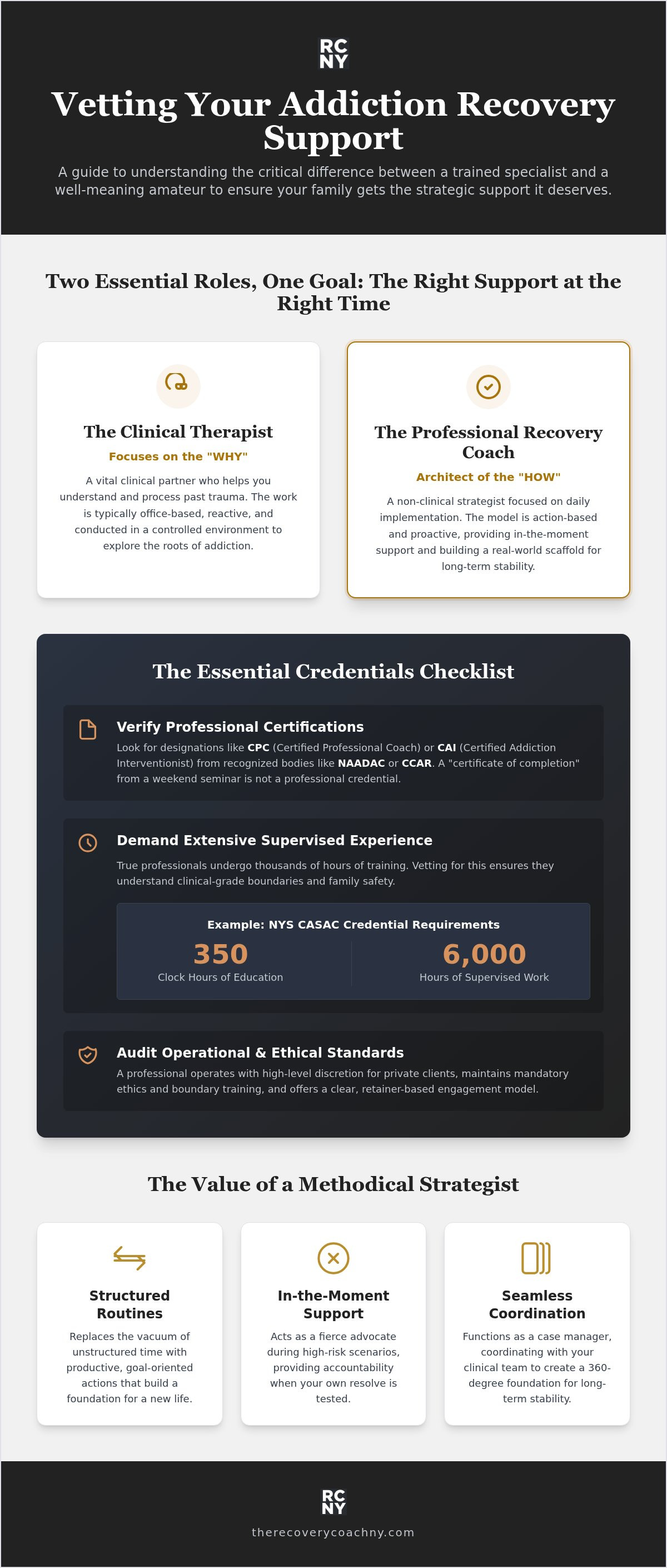
You might find yourself sitting in a quiet office, unpacking years of trauma with a licensed clinician. You might feel a sense of relief in those fifty minutes, only to feel the weight of the world crash back down the moment you step onto the sidewalk. This is the fundamental gap in traditional care. While a therapist is a vital clinical partner who helps you understand the "why" of your addiction, a professional recovery coach is the architect of the "how." They are non-clinical partners focused on daily implementation, moving recovery from the realm of theory into the reality of your living room, your office, and your social circles.
The "office-based" model of therapy is often reactive, addressing crises after they occur or processing emotions in a controlled environment. In contrast, the coaching model is action-based and proactive. It serves as the missing link during the fragile transition of early recovery. To truly understand this distinction, it helps to ask, What is a Recovery Coach? A coach doesn't just listen; they navigate the storm with you. When you are searching for an addiction interventionist New York families can trust, you are looking for someone who doesn't just diagnose the problem but builds a scaffold around your daily life to prevent a collapse.
The Role of Accountability in Coaching
Professional coaching moves the needle from broad emotional truths to specific, granular actions. It is the methodical strategy for a high-stakes business dinner where alcohol is flowing. It is the structured routine that replaces the vacuum of a lonely Sunday afternoon. A coach provides in-the-moment support during high-risk scenarios, acting as a fierce advocate for your recovery goals when your own resolve is tested. This level of accountability isn't about shame; it is about the creation of a solid foundation through small, daily victories that eventually lead to a transformed life.
When to Choose a Coach Over (or With) a Therapist
Therapy alone is often insufficient when the chaos of addiction requires constant, 24/7 vigilance. If you find that previous treatment attempts failed because the support ended at the clinic door, a coach is the necessary addition. An addiction interventionist New York specialist often functions as a case manager, coordinating with your therapists and doctors to ensure everyone has a 360-degree view of your progress. This collaborative relationship ensures that your clinical breakthroughs are supported by real-world habits. Choosing a coach means you aren't just healing your past; you are actively engineering a future where long-term stability is the new baseline.
The Essential Credentials Checklist: Verifying Professional Certification
You deserve more than just a well-meaning peer who has walked a similar path. You need a vetted professional who understands the complex mechanics of behavior change and family systems. When searching for an addiction interventionist New York families often encounter individuals with "lived experience" but no formal training. This is a dangerous gamble. A true professional holds credentials from recognized bodies like the Connecticut Community for Addiction Recovery (CCAR) or the Association for Addiction Professionals (NAADAC). Look specifically for the Certified Professional Coach (CPC) or Certified Addiction Interventionist (CAI) designations. These aren't just titles; they represent a commitment to a rigorous, audited standard of care.
Recognized Certification Bodies
A "certificate of completion" from a weekend seminar is not a professional certification. In New York, the Office of Addiction Services and Supports (OASAS) sets the bar exceptionally high for those providing clinical-adjacent care. For instance, the CASAC credential requires 350 clock hours of approved education and up to 6,000 hours of supervised work experience. This level of training ensures the coach understands SAMHSA's Definition of Peer Support while maintaining the clinical-grade boundaries necessary for family safety. Ongoing ethics and boundary training are mandatory for anyone claiming professional status. These standards protect you from the "amateur" who might cause more harm than good during a crisis.
The Importance of Supervised Experience
Why is supervision so critical? Lived experience provides empathy, but supervised practice provides the objective distance needed to navigate a multi-layered crisis. A coach who works within a larger professional network or agency has access to collective wisdom and peer review. This structure prevents the "lone wolf" mentality that often leads to boundary crossings or burnout. When you vet an addiction interventionist New York, ask about their history of supervised practice. Do they carry active liability insurance? Are they members of professional organizations like the International Coaching Federation? These markers indicate a practitioner who views their work as a high-level discipline. If you're ready to move toward a more structured solution, exploring private recovery coaching can provide the professional oversight your family requires to find lasting stability.
A professional coach also maintains active liability insurance and professional memberships. These aren't just administrative boxes to check; they're evidence of a methodical strategist who respects the gravity of the situation. They should be able to provide proof of their credentials and a clear explanation of their ethical guidelines upon request. This transparency is the first step in building the trust necessary for a successful partnership.
Evaluating Specialized Experience: Beyond Basic Certification
You've likely realized that sobriety is only one piece of a much larger puzzle. While a basic certification confirms that a coach understands the fundamentals of recovery, it doesn't guarantee they have the strategic depth to handle your family’s specific complexities. When interviewing an addiction interventionist New York families must look for a partner who understands that substance use is often a symptom of deeper, unaddressed challenges. Whether you're dealing with a young adult struggling to launch or a high-level professional whose career is on the line, the coach's experience must match the specific terrain of the client's life.
Managing Dual Diagnosis and Mental Health
It's rare for addiction to exist in a vacuum. Most often, it's intertwined with co-occurring disorders like ADHD, anxiety, or depression. A professional coach must have the clinical literacy to understand how these conditions influence behavior and decision-making. They don't replace the psychiatrist, but they act as a methodical strategist who ensures the treatment plan is actually followed between appointments. This requires constant coordination with medical professionals to monitor medication adherence and emotional stability. Holistic case management is the intentional integration of every life system, from medical care to social support, into a unified and sustainable recovery plan. Without this 360-degree view, the risk of a "revolving door" treatment cycle remains dangerously high.
Specialized Coaching for Life Transitions
Recovery doesn't happen in a sterile environment; it happens in the classroom, the boardroom, and the family home. Each of these settings requires a different set of tools and a specific type of advocacy. A coach should be a practical architect who can build routines tailored to the client's current stage of life. This might involve:
Academic Coaching & Scholastic Support: Helping students navigate the unique triggers of a campus environment while managing their educational responsibilities.
Executive Function & Accountability Coaching: Providing high-level professionals with the tools to manage stress, time, and social obligations without reverting to old coping mechanisms.
The Elder Coach NY: Addressing the specific needs of seniors, where late-life addiction often intersects with grief, medical frailty, and social isolation.
Choosing a specialist means you aren't just hiring a companion; you're hiring a fierce advocate who knows how to navigate the specific systems your loved one inhabits. This specialized focus transforms the recovery process from a struggle for cessation into a proactive journey toward a high-quality, functional life. An addiction interventionist New York with this level of expertise provides the "calm in the storm" that comes from having seen, and solved, these exact challenges many times before.
Operational Standards and Discretion: The Professionalism Audit
Vetting an addiction interventionist New York requires a deep dive into their operational DNA. It isn't enough to have a certification; you need to know how they handle the delicate logistics of a high-profile life. A professional audit ensures that the person you bring into your inner circle operates with the same level of precision and discretion you expect from any other high-level consultant. Before committing, you should walk through these five essential steps:
Step 1: Inquire about specific privacy and confidentiality protocols designed for high-profile clients.
Step 2: Review the structure of the engagement, noting if they utilize hourly or retainer-based models for consistent support.
Step 3: Evaluate the coach’s communication rhythm with both the family and the clinical team to ensure a 360-degree view of care.
Step 4: Confirm 24/7 availability and their specific protocols for emergency crisis management.
Step 5: Assess the logistics of sober companion services and safe transport for local or international travel.
The Private Pay and Discretion Advantage
The choice between insurance-based care and a private-pay model is often a choice about your future. Insurance companies require a "medical necessity" label, which creates a permanent clinical record that can follow a professional or student for years. Private-pay models bypass this, offering a level of discretion that protects your legal and professional standing. This concierge approach allows for personalized support that isn't dictated by the rigid boxes of an insurance form. It gives you the freedom to build a plan around your life, not a policy, providing a sense of "calm in the storm" that comes from true privacy.
Safe Transport and Sober Companionship
Sometimes the crisis is too intense for a simple weekly meeting. In these moments, you need boots on the ground. A professional addiction interventionist New York should provide seamless logistics for safe transport to and from treatment facilities, whether that’s across town or across an ocean. If 24/7 support is required, the criteria for selecting a sober companion must be rigorous. They aren't just babysitters; they are trained specialists who manage high-risk travel and international trips with methodical precision. They act as a buffer between the client and the triggers of the outside world, ensuring that the transition from treatment to home is secure.
Communication rhythm is the heartbeat of this process. Your coach should provide regular, structured updates to ensure everyone is aligned on the path forward. They must be available 24/7 for emergency crisis management, acting as the steady hand when things feel like they're falling apart. If you need a partner who operates with this level of elite professionalism, you can learn more about our concierge recovery services and how we protect your family’s privacy while building a foundation for change.
The Recovery Coach NY: A Foundation of 35 Years of Experience
Thirty-five years of industry experience isn't just a number; it's a reservoir of resilience that isn't easily rattled by complex, multi-layered crises. The Recovery Coach NY, led by Cindy Feinberg, CPC, CAI, represents the gold standard for families who require more than just a temporary fix. When you partner with an addiction interventionist New York families have trusted for decades, you're hiring a methodical strategist who understands the delicate architecture of rebuilding a life. Cindy’s authority is built on a foundation of high-touch, private care that bridges the gap between clinical theory and the messy reality of daily existence. She functions as a trusted insider in the recovery industry, navigating the system with a level of insight that only comes from a lifetime of advocacy.
A Compassionate, High-Level Guide
Our approach strikes a sophisticated balance between deep empathy and unwavering professional authority. It intentionally avoids the clinical coldness often found in large medical institutions, opting instead for a tone that is profoundly understanding and non-judgmental. We act as a "calm in the storm," acknowledging your fear and exhaustion while projecting a sense of steady, experienced hope. This isn't about restriction; it’s about creating a solid foundation for daily functioning and quality of life. Whether you are in the heart of Manhattan or halfway across the globe, our practice offers high-level support, including 24/7 sober companions and safe transport worldwide. We remain accessible and deeply grounded in human connection, even as we manage the most elite and complex cases.
If you are looking for similar professional recovery support and intensive workshops internationally, you can visit Sober Coach to learn more about their personalized coaching services.
Starting the Journey to Sustainable Recovery
The path forward begins with a comprehensive initial assessment to understand the unique systems surrounding the individual and their family. We don't believe in the confrontational models of the past. Instead, we create a customized recovery roadmap that addresses addiction, mental health coordination, and executive function. Our long-term goal is to foster the independence and resilience needed to thrive without constant intervention. As a fierce advocate for the client and a seasoned addiction interventionist New York specialist, we ensure that every doctor, therapist, and family member is aligned with the same methodical strategy. This creates a steady, reliable pulse of care that suggests a well-organized and highly responsive system. If you're ready to move from a state of distress toward a sense of organized relief, reach out for a private consultation with The Recovery Coach NY today. We are here to provide the firm, supportive hand you need to navigate this transition with dignity.
Building a Foundation for Lasting Stability
You've learned that a professional recovery coach is the architect of daily implementation. You now know how to verify credentials and why specialized experience in dual diagnosis is non-negotiable. Finding an addiction interventionist New York families can trust means looking for a strategist who coordinates every aspect of care, from academic support to clinical transitions. It's about moving beyond the office-based model into a proactive, action-oriented way of living that prioritizes long-term functioning over temporary fixes.
Led by Cindy Feinberg, CPC, CAI, with over 35 years of industry experience, our practice provides comprehensive case management that addresses the whole person. We offer 24/7 global support for crisis and transition management, ensuring you have a partner who is both a fierce advocate and a methodical strategist. You don't have to navigate this storm alone. If you're ready to secure the professional guidance your family deserves, it's time to connect with a Certified Recovery Professional Today. There is hope for a steady, resilient future, and we are here to help you build it.
Common Questions About Professional Recovery Support
What is the difference between a certified recovery coach and a sober companion?
A recovery coach functions as a high-level strategist who builds your long-term roadmap, while a sober companion provides immediate, 24/7 accountability. Think of the coach as the architect and the companion as the daily onsite supervisor. Both roles are essential for different stages of the process, but the coach focuses on systems while the companion focuses on physical presence and safe transitions.
How much does a private certified recovery coach typically cost?
Private coaching fees are typically structured as either a retainer for comprehensive case management or an hourly rate for specific sessions. Because these services are high-touch and concierge-level, they reflect the expertise of a seasoned professional. We recommend discussing your specific needs during an initial consultation to understand which model provides the most value for your family's unique situation and goals.
Can a recovery coach help if my family member refuses to go to rehab?
Yes, an addiction interventionist New York specialist can begin working with a family even before the individual is ready for residential treatment. We use motivational strategies and family systemic work to shift the household dynamic. This proactive approach often creates the necessary environment for the individual to eventually choose a higher level of care on their own through a non-confrontational process.
Is recovery coaching covered by insurance?
Recovery coaching is a private-pay service and is not typically covered by insurance. This model is intentional, as it allows for maximum discretion and avoids the "medical necessity" labels that can impact a client's permanent record. By opting for private support, you maintain full control over the privacy and duration of the engagement without outside interference or restrictive clinical requirements.
How long does a typical coaching engagement last?
Engagements usually range from three to six months for the initial foundational phase, though many families continue for a year or more. The goal is to move from high-intensity support to sustainable independence. We adjust the communication rhythm as the client builds resilience, ensuring the scaffold of support remains as long as it's truly beneficial for daily functioning and stability.
What qualifications should I look for in a crisis interventionist?
Look for the Certified Addiction Interventionist (CAI) or Certified Professional Coach (CPC) designations. It's also vital to find someone with a history of supervised practice and a deep understanding of dual-diagnosis cases. A qualified interventionist should be a methodical strategist who can remain calm during a crisis while coordinating multiple moving parts of a family's life with professional authority.
If you are interested in learning more about the rigorous educational standards for executive and organizational coaching, click here.
Can a recovery coach help with mental health issues if there is no addiction?
Absolutely, we provide mental health support and executive function coaching for individuals who aren't struggling with substance use. Many clients utilize our services to manage ADHD, anxiety, or scholastic challenges. We focus on building the practical routines and accountability structures that help anyone navigate life’s transitions more effectively, regardless of their history with addiction or previous treatment attempts.
How does a coach coordinate with my current therapist or doctor?
A professional coach functions as a case manager who maintains regular contact with your clinical team. We share updates on daily progress and behavioral trends that a therapist might not see in a once-a-week session. This creates a 360-degree view of your recovery, ensuring that clinical breakthroughs are supported by real-world habits in your home, school, and professional life.